Buying Guide
Your First Serious Watch:
Budget Tiers, Movements and What Each Buys
Moving from a fashion watch to a genuine mechanical timepiece is one of the more satisfying purchases you can make — and one of the easiest to get wrong by buying on looks alone. This guide walks through the decisions in order: how much to spend and what that money actually buys, automatic or quartz, which style fits your life, the specifications that matter, and where to buy without getting burned.
Step 1: Understand What Each Budget Tier Buys
Watch quality does not rise smoothly with price; it steps. Knowing where the steps are stops you paying for a tier you do not need — or stopping just short of one that matters to you. Prices below are deliberately described as tiers rather than figures; the catalog cards further down show current Amazon.com prices.
Entry tier: Japanese automatics
This is where the Seiko 5 Sports, Orient Bambino and Invicta Pro Diver live. You get a genuine automatic caliber (Seiko 4R36/NH35, Orient in-house) with hacking and hand-winding, a stainless steel case, real water resistance (30m on the Bambino, 100m on the Seiko, 200m on the Pro Diver) and a mineral crystal. You do not get sapphire, Swiss Made, hand-applied finishing or a long power reserve. The movement — the part that matters most — is excellent for the money; the compromises are all on the outside.
Mid tier: better Japanese and entry Swiss
Here sapphire crystal becomes standard, cases are finished with crisper brushing and polishing, and you start seeing Seiko's 6R calibers, Orient Star, Citizen's higher-grade movements and the first Swiss-made watches on ETA or Sellita calibers. Brand heritage and after-sales networks come with the Swiss options. This tier is the natural second watch rather than the first.
Swiss tier: Tissot PRX and similar
The Tissot PRX in our catalog marks the start of this tier: Swiss Made, sapphire crystal with anti-reflective coating, an integrated bracelet, and the Powermatic 80 caliber with up to 80 hours of power reserve. Competitors at this level include Hamilton's Khaki Field and Longines' entry models. What you are paying for over the entry tier is finishing, crystal, power reserve and brand — not a fundamentally different wearing experience, which is why many people are happy to stay at entry level for years.
The budget rule
Buy the best watch you can afford without noticing the money. A watch at any of these tiers will outlast you with reasonable care, and an entry-tier automatic worn daily gives more pleasure than a Swiss watch bought with a wince. If you later discover you love mechanical watches, the step up is waiting; if you discover you do not, you have lost little.
Step 2: Automatic or Quartz?
For a first "serious" watch we generally suggest an automatic, because the mechanical nature is most of the appeal: a self-winding movement, the sweep of the seconds hand, a machine that runs on your own motion. The honest counter-argument is that a quartz watch is more accurate, needs almost no care and keeps running when left in a drawer. If accuracy and convenience matter more to you than craft, quartz is the correct answer and nothing to apologize for. See automatic vs quartz for the full comparison and quartz movement explained if you want to understand what a listing means by it.
Step 3: Choose a Style for Where You Will Wear It
- Business, office, formal: a dress watch — slim, clean dial, leather strap or elegant bracelet. Orient Bambino or Tissot PRX. See dress & designer watches.
- Everyday casual to business casual: something that is neither too formal nor too sporty — the PRX on its bracelet, or a Seiko 5 Sports on leather. Our office watch guide reads the dress codes.
- Active, outdoors, water: a sport or dive watch with 100m or more — Seiko 5 Sports, Invicta Pro Diver. See diver & sports watches.
A versatile everyday watch is usually the right first purchase: one you can wear Monday to Friday and at the weekend without it looking out of place in either.
Step 4: The Specifications That Actually Matter
- Movement origin and caliber: a named Japanese (Seiko, Orient, Miyota) or Swiss (ETA, Sellita, Powermatic) caliber means parts and service are available anywhere. Our automatic watch overview compares the calibers in our catalog.
- Case diameter and lug-to-lug: 38–42mm suits most wrists; lug-to-lug decides whether it overhangs. Sizing guide →
- Crystal: sapphire is close to scratch-proof; mineral is fine but will show its age. Sapphire vs mineral →
- Water resistance: 50m minimum for everyday wear, 100m if you swim. Ratings explained →
- Power reserve: about 40 hours on entry-level calibers, up to 80 on the Powermatic 80 — this is what decides whether the watch is still running on Monday. Power reserve explained →
- Hacking and hand-winding: both make the watch easier to live with; every caliber in our catalog has both.
Step 5: Buy From a Reliable Source
For a first watch, an established marketplace or authorized dealer with a clear return policy is the safe route: you can send back a watch that is too large, and you are protected against the two risks that catch beginners — counterfeits and grey-market watches sold without a manufacturer warranty. Avoid private sellers until you can authenticate a watch yourself; our guide to spotting a fake explains the checks.
Starter Picks — One Per Tier
Three watches that illustrate the tiers above: an entry sport automatic, an entry dress automatic and a Swiss automatic. All are linked to current Amazon.com listings; the listing is always the authoritative source for price and specification.
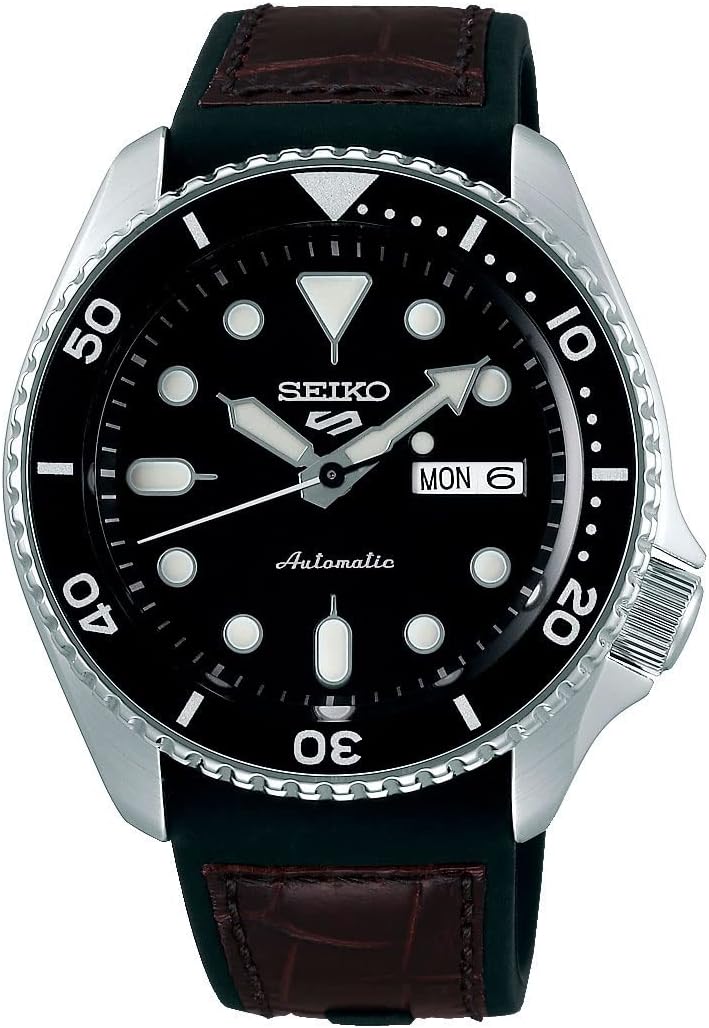
Seiko 5 Sports SRPD83K1 Automatic Watch — Black Dial, Nylon Strap, 100m WR, Day/Date
$89.95
Price on Amazon.com at time of retrieval; taxes and shipping may apply

Orient 2nd Gen Bambino Ver. 2 Automatic Dress Watch for Men — Japanese Automatic, Leather Band
$179.00
Price on Amazon.com at time of retrieval; taxes and shipping may apply

Tissot PRX Swiss Automatic Watch for Men — Blue Dial, Stainless Steel Integrated Bracelet, 40mm
$595.00
Price on Amazon.com at time of retrieval; taxes and shipping may apply
What to Expect From Your First Automatic
It will drift a few seconds a day — entry-level calibers are specified at roughly -20/+40 seconds, and most do better. It will stop if you leave it off the wrist for two days, and you will hand-wind it on Monday morning. It will need its first service in five to eight years. None of this is a defect; it is what owning a mechanical object is like, and most people find the watch becomes more interesting the longer they own it. Two guides answer the questions that come up in the first month: how accurate should it be? and why did it stop overnight?
For continued reading, the guide library covers complications, straps, storage, servicing and insurance; building a first collection is the natural next step once the first watch has settled in.